
Liquid metal thermal paste and traditional silicone thermal paste are the two most debated thermal interface material (TIM) options in the industry today. As chip power density keeps climbing — from consumer electronics to servers, EVs, and 5G base stations — thermal design has become a critical factor in product reliability and lifespan. Among various thermal interface materials (TIM), thermal grease has long been the mainstream choice for filling microscopic gaps between heat sinks and chips and reducing contact thermal resistance, thanks to its ease of application and relatively low cost. In recent years, however, liquid metal thermal paste has drawn growing attention from enthusiasts and engineers, and is frequently compared with traditional silicone-based thermal paste. The two materials differ significantly in thermal performance, usage risk, and suitable applications — choosing the wrong one can hurt cooling performance or even damage equipment. This article compares material properties, pros and cons, key performance metrics, and application recommendations to help you find the thermal paste that best fits your needs.
Silicone Thermal Paste: The Stable, Reliable Mainstream Choice
Traditional thermal paste is typically based on silicone oil, blended with thermally conductive fillers such as zinc oxide, boron nitride, aluminum oxide, or silver powder. It remains the most widely used thermal interface material on the market today.
Pros:
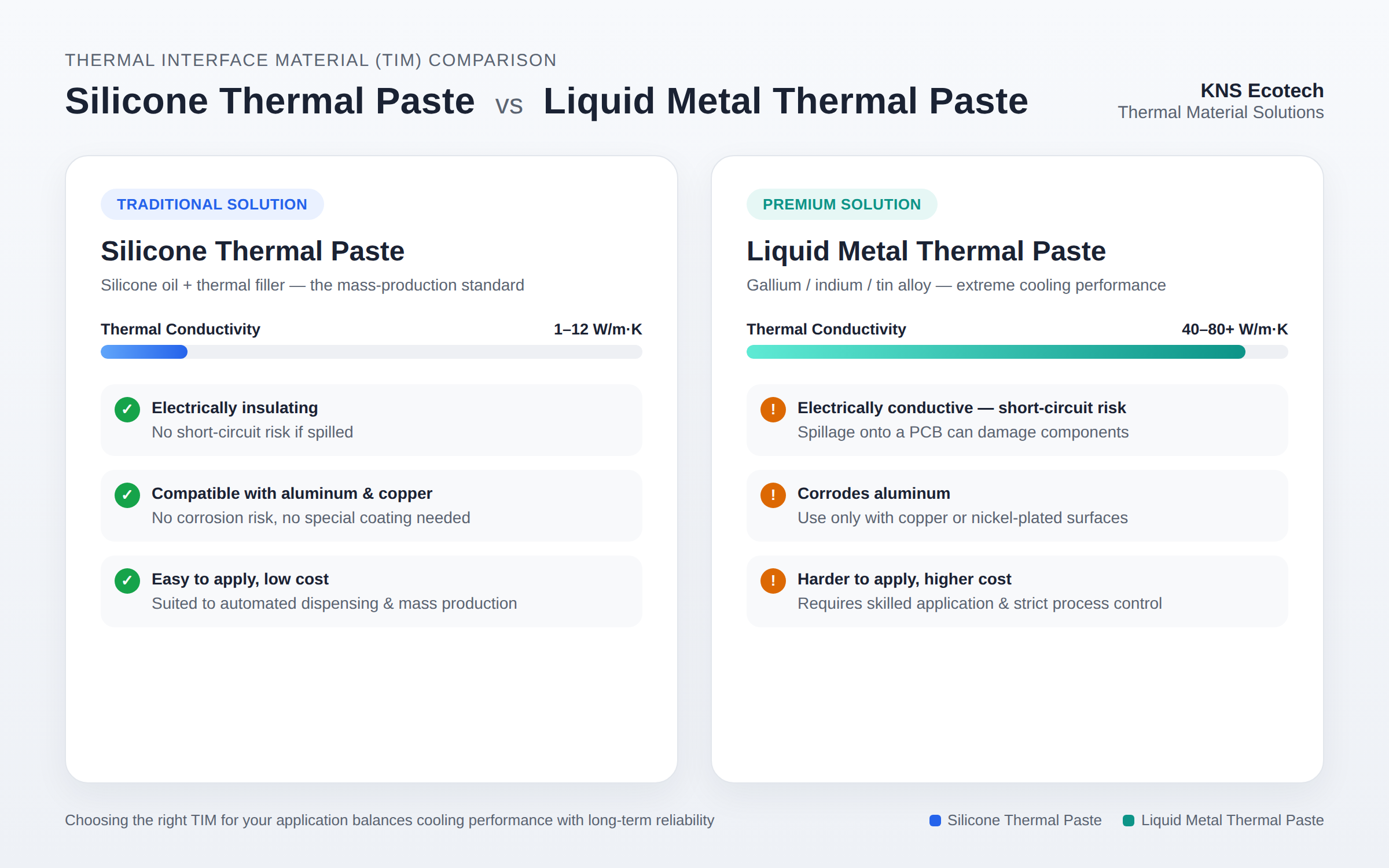
- Electrically insulating: Non-conductive, so accidental spillage onto a circuit board or other components won’t cause a short circuit — a high margin of safety
- Good chemical compatibility: No corrosion concerns with common heat sink materials like aluminum or copper; no special coating required
- Easy to apply: Moderate viscosity makes it easy to spread and clean, suitable for high-volume production and automated dispensing
- Lower cost: Material and process costs are far below liquid metal, suitable for large-scale mass production
- Flexible formulations: Thermal conductivity can be tuned to the application (roughly 1–12 W/m·K, higher with specialty formulations), along with hardness and temperature range
Cons:
- Thermal conductivity is generally lower than liquid metal, limiting cooling performance in high power-density applications
- Long-term use may lead to “pump-out” or bleed-out, degrading thermal performance over time
- Some lower-cost products can dry out and crack under high temperatures, requiring periodic reapplication
Liquid Metal Thermal Paste: A Premium Option for Extreme Cooling Performance
Liquid metal thermal paste is primarily composed of low-melting-point metal alloys such as gallium, indium, and tin, appearing liquid or paste-like at room temperature. Its thermal conductivity can reach 40–80+ W/m·K — several times to over ten times higher than silicone-based paste.
Pros:
- Extremely high thermal conductivity: Significantly reduces interface thermal resistance, ideal for high-power, high-heat-flux chips
- Better long-term stability: Less prone to the drying/cracking or pump-out issues common with grease-type paste
- Excellent wetting properties: Fills microscopic surface pores, reducing contact thermal resistance
Cons:
- Electrically conductive: Spillage onto a circuit board, capacitor, or other component can cause a short circuit or permanent damage
- Corrodes aluminum: Gallium reacts chemically with aluminum, making it brittle — liquid metal must never be used directly on aluminum heat sinks or vapor chambers, and should only be paired with copper or nickel-plated copper substrates
- Harder to apply: Low viscosity and high fluidity require greater skill and experience to apply and control, along with careful cleanup of residue
- Can alloy with certain metals (amalgamation): Prolonged contact with copper may cause diffusion or penetration, shortening service life; nickel-plated interfaces are generally recommended
- Higher cost: Material and process costs are notably higher than silicone-based products, and require greater operational and technical expertise
Key Metrics Compared
- Thermal conductivity: Silicone paste ~1–12 W/m·K; liquid metal ~40–80+ W/m·K
- Electrical properties: Silicone paste is insulating; liquid metal is conductive and requires strict spill prevention
- Material compatibility: Silicone paste works with both aluminum and copper; liquid metal corrodes aluminum and should only be paired with copper or nickel-plated surfaces
- Ease of application: Silicone paste is easy to apply and suited to automated production lines; liquid metal requires specialized skills and tight process control
- Long-term stability: Silicone paste may experience pump-out or drying/cracking; liquid metal offers better long-term thermal stability but requires attention to amalgamation
- Cost: Silicone paste is low-cost and suited to mass production; liquid metal costs more and is typically used in premium or custom applications
Liquid Metal vs. Silicone Thermal Paste: How to Choose Based on Your Application
For most consumer electronics, home appliances, LED lighting, power supplies, and similar applications, traditional silicone thermal paste remains the most practical choice in terms of safety, cost, and process compatibility — and it’s still the mainstream solution for industrial mass production today. Liquid metal, on the other hand, is better suited to applications demanding extremely high cooling performance where short-circuit and corrosion risks can be effectively managed through design (e.g., copper base plates, nickel plating, professional assembly processes) — such as high-performance computing (HPC) servers, AI accelerator cards, overclocked gaming PCs, and certain EV power control modules with demanding power density requirements.
KNS Ecotech: Thermal Solutions Built Around Material Properties
KNS Ecotech has long focused on the R&D and application of thermal interface materials, offering a diverse product line including thermal paste, thermal pads, and thermal gel, with tailored material recommendations for sectors such as networking equipment, EVs, and energy storage systems. Whether your product is a consumer electronics device built for stable mass production or a high-power application demanding exceptional thermal performance, our team welcomes the opportunity to help you evaluate the most suitable thermal material solution.